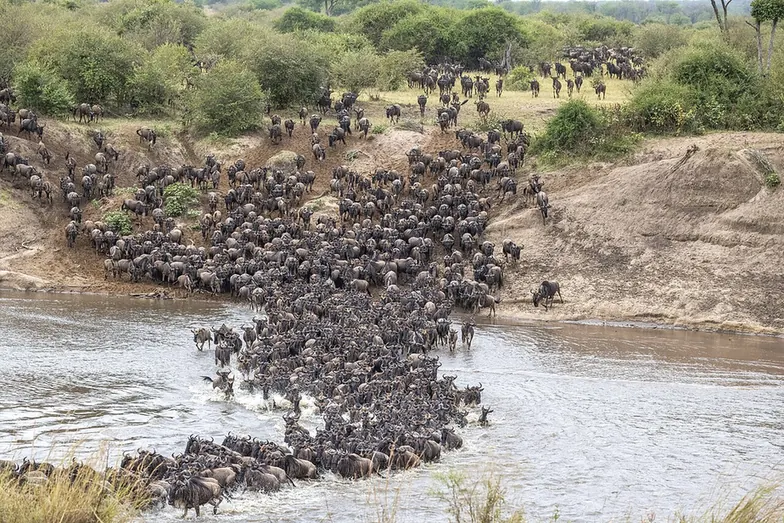
Use a calendar as a broad orientation
Rainfall, grazing and herd movements affect where the animals are. A month label cannot tell you which bank a herd will reach or whether it will cross while you are present. Ask a guide what is happening now and be prepared for a worthwhile game drive without a crossing.
| Period | What the primary evidence supports | Mara Triangle adult non-resident entry |
|---|---|---|
| January-March | Southern calving is a Tanzania question; exact current calving dates not verified here | USD 100 |
| April-May | Do not assume the northern migration is present; request dated observations | USD 100 |
| June | Within the Conservancy’s broad June-July arrival window, not a promised arrival | USD 100 |
| July | Possible arrival and northern-phase viewing; timing varies | USD 200 |
| August-September | A popular focus, but historical reports show herds can leave after rain | USD 200 |
| October-November | Within the Conservancy’s broad season extending to November; check current conditions | USD 200 |
| December | No verified herd-location forecast; assess the Mara on its wider merits | USD 200 |
The entry-price calendar is a tariff, not a wildlife calendar. Accommodation prices and crossing probabilities are not verified by this table. We have not confirmed an official fixed December-March calving window and do not present one as established.
Sources: Mara Conservancy - migration season and viewing rules · Mara Conservancy - monthly reports, including August 2025 · Mara Conservancy: conservation fees
Why an August booking is still uncertain
Mara Conservancy’s August 2025 report describes heavy rain followed by the migration returning to Tanzania, with very few wildebeest remaining in the Mara shortly afterwards. This is a concrete historical example of why a popular month is not a guarantee.
The Conservancy’s general migration page describes a season beginning around June-July and continuing to November. Use that broad context to choose an area, then ask for recent dated observations. Neither statement supports a precise crossing appointment or a forecast of next year’s herd positions.
Sources: Mara Conservancy - migration season and viewing rules · Mara Conservancy - monthly reports, including August 2025
What a river-crossing day can involve
A crossing-focused drive may involve long periods waiting, changes of position and crowded viewpoints. Decide before booking whether that is how you want to spend your holiday. Seeing predators, resident herbivores and the landscape can be a better use of a day than repeatedly chasing unconfirmed reports.
Follow the guide’s and reserve’s rules. Vehicles should not block animals’ approach or pressure a herd into the river. A dramatic photograph is not a reason to leave permitted tracks, crowd wildlife or demand that a driver race between sightings.
Kenya and Tanzania are not interchangeable bookings
The Maasai Mara and Serengeti belong to a connected ecosystem but sit in different countries with separate park systems and travel logistics. A camp name near a border does not mean your vehicle can simply continue to the other side. Border crossings, flights and permissions need a real itinerary.
For calving-focused travel, investigate the southern Tanzanian ecosystem and current guiding information. A Kenya-only route should not advertise the southern calving season as an attraction it can deliver. For a Mara trip, value the resident wildlife and landscape as well as the possibility of migratory herds.
Sources: UNESCO: Serengeti National Park · Tanzania National Parks: official park information · Mara Conservancy: visitor information
Fees and accommodation choices
Mara Triangle’s published entry price changes by season, and conservancy and reserve charges are separate questions. A camp’s location influences how much of the day is spent reaching river areas. Compare the actual gate, driving area and inclusions rather than choosing only by the phrase “migration camp”.
Allow several opportunities if crossings are your main interest, but understand that more nights improve flexibility rather than creating a guarantee. Our suggested stay lengths are planning advice, not a measured probability model.
Sources: Mara Conservancy: conservation fees
Questions to ask before paying
Ask where the camp operates, how the guide decides the day’s route, whether reserve entry is included and how much flexibility you have to pursue a different interest. Request a clear distinction between the operator’s recent observations and its general seasonal description.
Avoid treating an old video, an undated photo or a report from the other side of the ecosystem as evidence of today’s conditions. A useful update names the location and observation date and acknowledges when the herds have moved.
Sources: Mara Conservancy: visitor information · Tanzania National Parks: official park information
Questions & answers
What day will the wildebeest cross the Mara River?
No dependable calendar can promise a crossing day. Herd decisions and local conditions make this unpredictable.
Is the calving season in Kenya?
The southern Serengeti ecosystem’s calving focus is in Tanzania. It should not be sold as a Kenya-only itinerary feature.
Is August a guarantee?
No. A popular month can still produce days without a crossing at your location.
Should I skip the Mara outside migration months?
Not necessarily. Decide whether its resident wildlife, landscape and available activities fit your interests independently of the migrating herds.
Sources & verification
Checked on 21 September 2026. Prices apply only to the visitor category and dates stated. Route timings, suggested stays and budget scenarios are editorial planning estimates unless a source is specified.
- UNESCO: Serengeti National Park - checked 20 September 2026.
- Mara Conservancy: visitor information - checked 20 September 2026.
- Mara Conservancy: conservation fees - checked 20 September 2026.
- Tanzania National Parks: official park information - checked 20 September 2026.
- Mara Conservancy - migration season and viewing rules - checked 21 September 2026.
- Mara Conservancy - monthly reports, including August 2025 - checked 21 September 2026. Historical observations demonstrate variability; they do not predict the next season.
Published · Updated . Send a correction.